Osaka and Hiroshima were both prime targets during WWII and so the story of how two war-ravaged cities turned out to be some of the most fun, energetic, and colorful places we visited is a testament to the resilience of the Japanese and their focus on rebuilding after the Second World War.
Osaka is the beating heart of Kansai, the central prefecture in Japan. It's know for good eatin' and great people watchin' - it's a work hard, play hard town that is even more charming at night as the neon city comes to life. It's a major port city and the 2.65 million residents are impatient, sometimes gruff, and always colorful. The city has a true energy about it - a pervasive beat that you can feel as you walk down the sidewalk under the glaring light and the constant noise. After mediating in the Buddhist temple that morning - this definitely woke our slumber!


Osaka is the beating heart of Kansai, the central prefecture in Japan. It's know for good eatin' and great people watchin' - it's a work hard, play hard town that is even more charming at night as the neon city comes to life. It's a major port city and the 2.65 million residents are impatient, sometimes gruff, and always colorful. The city has a true energy about it - a pervasive beat that you can feel as you walk down the sidewalk under the glaring light and the constant noise. After mediating in the Buddhist temple that morning - this definitely woke our slumber!
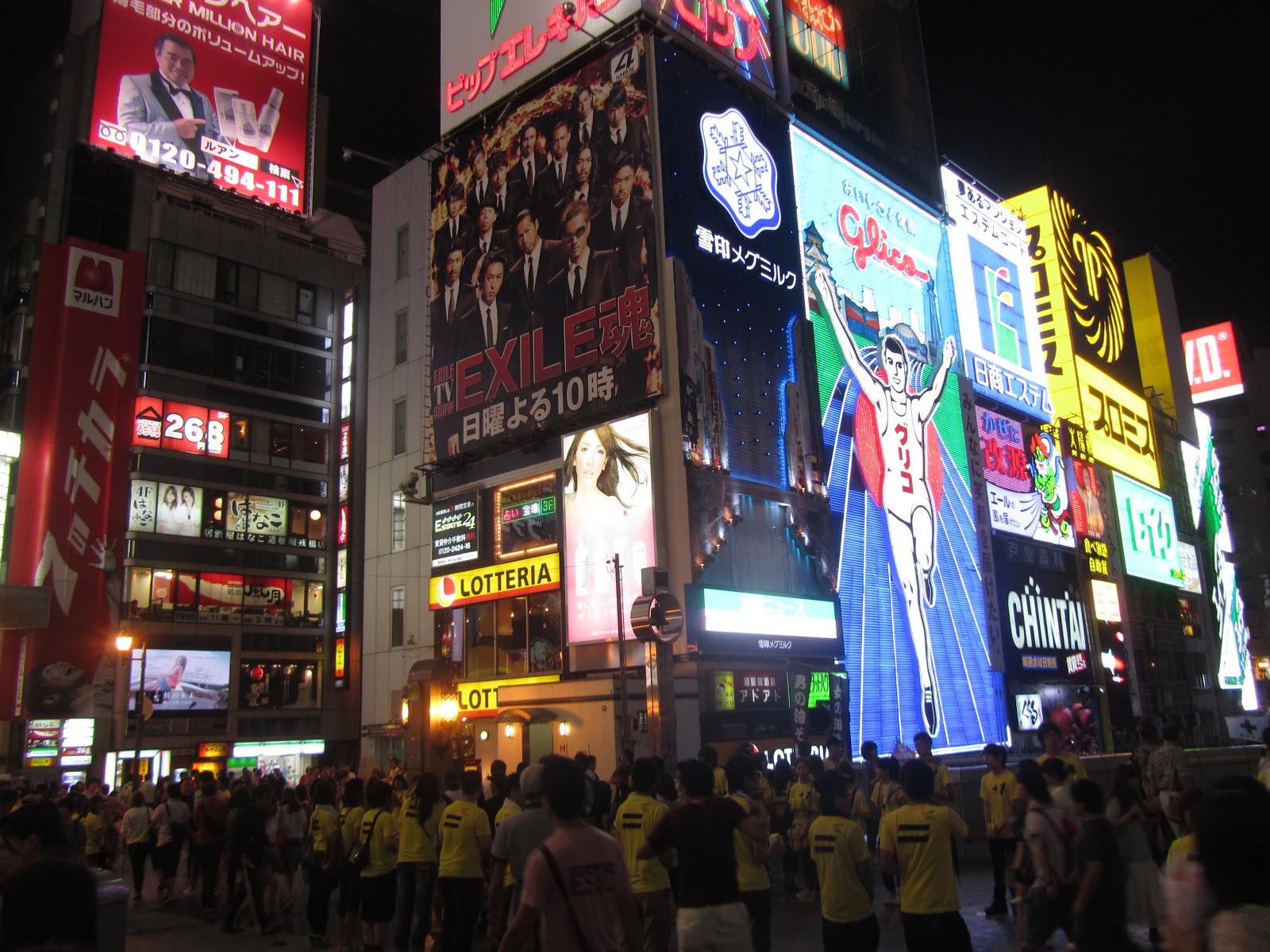
Dotombori is Osaka's liveliest nightlife areas. This is a the view from the famous Ebisu-bashi (bridge). It's packed with people and energy, and it's hard not to draw references to Times Square.

Osaka nightlife can turn you into a real hermit during the day, but we were insistent on seeing her top historical site Osaka-Jo (castle). Founded on this site at 1583 the castle has been rebuilt 3 times! The story inside depicts a fierce battle for dominance between Toyotomi Hideyoshi and Tokugawa Ieyasu to unify Japan.

Only a few several tons, Matt was kind enough to get the door for me.

Thank you hotel points. After sleeping on a hardwood floor in a temple, the room at the St. Regis seemed to suit us just fine! The hotel had a lovely patio on the 17th floor where they maintained their own zen garden.

Of course we could have stayed at one of the local "capsule" hotels - but I don't think our luggage would even have fit! These hotels are famous for usage by Japanese businessmen who have worked so late (or drank so much) that they missed their last train home to the suburbs.

One of Osaka's top attractions is their world-class aquariums, I'm sorry was I saying something - can't concentrate when I'm in a fish tunnel!
Here are just a few of our favorite critters:

The stately Empire penguins.

He's a little camera shy. (Probably because most people consider him lunch!)

This baby sea otter was getting a lot of attention from the girls and he seemed to want to flirt back.

The giant spider crabs look like aliens invaders, but I don't think they would be so scary if they were crab cakes?

Always weird and wonderful.

Reaching new heights! The pier at the aquarium had a giant Ferris wheel -it's said to be the largest in the world at 112 meters tall. From here you can see both Osaka and Kobe - where's the beef?

The Dotombori-gawa (river) is lit with lanterns the entire length of the city. Sometimes Osaka is so bright at night it's hard to remember what time it is!
On to Hiroshima!

After a night in Osaka we were headed South to Hiroshima. A two-hour train ride isn't bad when you can grab a beer and fresh gyoza at the train station. Why can't plane food be this good?

As soon as we checked into the hotel, I went to check out our view and the Mazda Zoom-Zoom (yup) Stadium was front and center. I immediately checked the schedule for the Hiroshima Carp (you know those terrifying large goldfish) and we were in luck! I scored two tickets for the following night.

Imagine my surprise when I arrive at the game to find the Philadelphia Fanatic's estranged Japanese cousin. It was so strange! Apparently they love to copy mascots from MLB teams. Of course, the Fanatic is a top choice. Imitation is the highest form of flattery!

Then it just got weird. The only sign in English in the whole ballpark and it's for a Philadelphia Cheesesteak. I wish I could tell you I took one look at that picture and turned away in digust. No, I promptly ordered one (it's my duty) - and only then could I confirm my disgust - gross!

During the 7th inning stretch they sing songs and fire off balloons. Only after perfectly sequencing the count-down. Honestly, these people can put order to anything!

I traded in my imitation cheesesteak for a steaming bowl of fresh udon noodles. Now that is a ballpark snack! Oh yeah and the "beer girls" sell sake instead!

The next morning we woke up early to travel to the island Miyajima, a Unesco World Heritage site, which was ranked one of the top three views in Japan. The vermilion torii (shrine gate) of the Itsukushima-jinja is considered one of the most beautiful sites in Japan. In ancient times the island was considered sacred and commoners could not step foot on the land - they could only sail a boat through this "floating" gate.


The island is home to a lot of friendly (and well fed) white-tailed deer. Some of whom (right) really like to test their limits.

Hiroshima is famous for its okonomi-yaki, a savoury pancake with veggies and meat or seafood cooked on a griddle and served with noodles. The serve them up fast and hot and you can't find a seat during lunch time! I think just one is all the energy you will need for a week!

Matt's good at taking pictures of everything else, but this trip my specialty was happy Japanese kids - they are adorable, plentiful and easily delighted. Great subjects! This gal was splashing around in mock tidal pool and was having fun man handling a giant snail. You go girl.

A shot of the torri just as the tide started to come in and the fog started to lift.

For most of the world Hiroshima means just one thing. The city will forever be remembered for the terrible instant on August 6, 1945 when it became the target of the world's first atomic-bomb attack. There are few words to express the heaviness in my heart as we approached ground-zero almost 66 years to-the-day of the attacks. It was a bright and clear, August morning for us, which was the same weather report from the bombing - in fact one of the reasons the city was chosen that day. There was an eerie sense of responsibility and sadness, but also a sense that to the Japanese this was history and the people of Hiroshima don't want this event to define them.

The bomb exploded almost directly above the Gembaku Domu, now known as the A-Bomb Dome. It is stunning that it is still standing after all the other materials vaporized. It was build in 1915 and served as a industrial exhibition hall. The city has decided to preserve it as a stark reminder of it's tragic past.

On the other side of the Motoyasu river stands the Peace Memorial Park and this cenotaph which contains the names of all the known victims as well as the Flame of Peace, which will only be extinguished once the last nuclear weapon on earth has been destroyed.

The Children's Peace Monument contains thousands and thousands of folded paper cranes from children around the world. The display was inspired by leukemia victim Sadako Sasaki. In 1955 at 11 years old she was diagnosed with the disease. She decided to fold 1000 paper cranes - the crane is the symbol of longevity and happiness - and she thought if she could reach her goal she would be cured. She sadly passed away before achieving her goal, but her classmates finished folding them for her. Now children around the world send their cranes to the memorial every year.

I was extremely touched when we came upon this field trip of Japanese school children, learning about the bombing. Their teacher was not angry or resentful, and she did not lay blame. She explained to them how important peace was in our world, and that their jobs were to make sure that something like this never happens again.

I saw a lot of peace signs during my time in Japan, but this was one place where I did not hesitate to flash one of my own.


